
Welcome to our book review of “Mao: The Unknown Story” by Jung Chang and Jon Halliday. In this groundbreaking biography, Chang and Halliday delve into the life and legacy of Chairman Mao, providing a captivating and comprehensive critique. Spanning 814 pages, this meticulously researched book aims to shatter the sympathetic portrayal of Mao, exposing the brutalities and atrocities committed during his rule.
Key Takeaways:
– “Mao: The Unknown Story” is a meticulous biography that examines the life and actions of Chairman Mao.
– The book challenges the myths and propaganda surrounding Mao, presenting a vivid portrayal of his brutality.
– Mao’s legacy continues to impact China’s history and has global implications.
– The writing style of the biography focuses on presenting factual information, but some readers criticize the lack of context and bias.
– Understanding Mao is crucial to understanding China’s history and its significance in the modern world.
Overview of Mao’s Life and Legacy
Mao Tse-Tung, also known as Chairman Mao, holds a significant place in Chinese history. Born in 1893 in the province of Hunan, he rose to power as the leader of the Chinese Communist Party and played a pivotal role in establishing the People’s Republic of China. However, it is crucial to recognize that Mao’s ascent to power came at an immense human cost.
With little regard for human lives, Mao pursued his goals, resulting in the deaths of millions of people, primarily through enforced famines. This disregard for human life and the atrocities committed during his reign have left a lasting impact on China and the world.
Despite the immense suffering caused by Mao’s leadership, he garnered international support during his time in power. Today, Mao remains a controversial figure, with ongoing discussions surrounding his legacy and the effects of his rule.
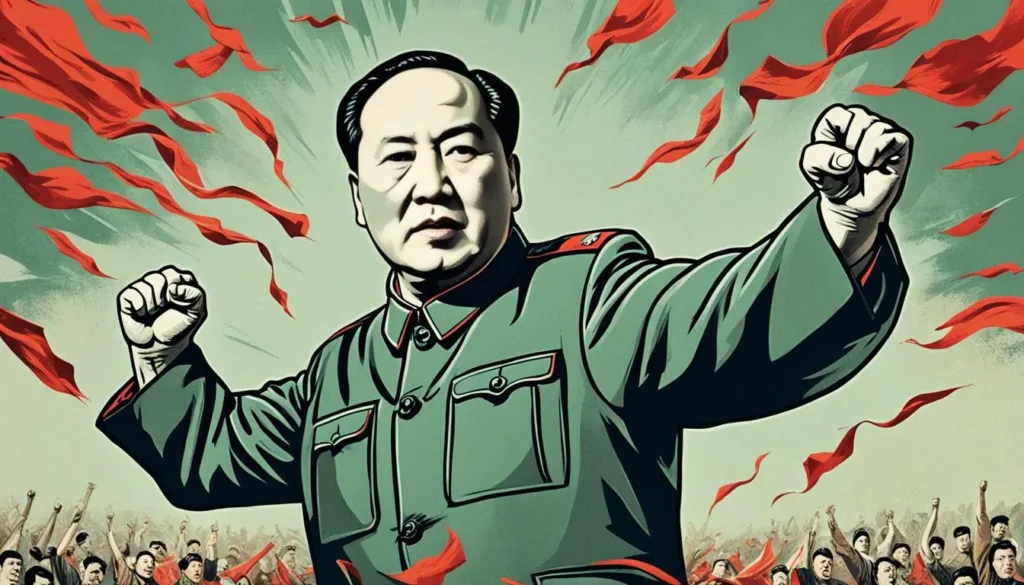
“Mao Tse-Tung, also known as Chairman Mao, holds a significant place in Chinese history. Born in 1893 in the province of Hunan, he rose to power as the leader of the Chinese Communist Party and played a pivotal role in establishing the People’s Republic of China. However, it is crucial to recognize that Mao’s ascent to power came at an immense human cost.”
Mao’s actions and their consequences resonate globally, extending beyond China’s borders. His influence on the global stage has been far-reaching, making him an important figure in discussions of global force projection.
The Scope of the Biography
Chang and Halliday’s biography of Mao is a comprehensive and meticulously researched work. Spanning from his birth to his death, the authors closely examine Mao’s life and actions. They aim to provide historical context and shed light on the motivations behind Mao’s decisions. While the focus remains on Mao, the authors also touch on other significant figures, such as Chou Enlai, and the worldwide implications of Maoism. The research involved extensive interviews, consultations of Chinese-language sources, and years of dedicated work.
Throughout their meticulous research, Chang and Halliday endeavor to present a comprehensive account of Mao’s life and legacy. By examining Mao’s actions within the historical context of China and the broader world, the authors provide a rich understanding of the motivations driving Mao’s decisions. While Mao takes center stage, Chang and Halliday also highlight the roles played by other supporting actors, such as Chou Enlai.
“We wanted to give readers a complete picture of Mao’s life, not just as an isolated figure, but as someone influenced by and influencing various historical forces,” Chang explained. “To do this, we conducted meticulous research, consulting a wide range of Chinese-language sources and conducting extensive interviews. It was an immersive and laborious process, but it allowed us to piece together a detailed narrative.”
The authors’ meticulous approach ensures that readers gain a deeper understanding of Mao’s actions and their wider implications. By providing historical context, Chang and Halliday enhance our appreciation of the motivations driving Mao’s decision-making. This comprehensive research also allows them to explore the worldwide implications of Mao’s ideological framework, known as Maoism.
The research conducted by Chang and Halliday involved in-depth interviews and the consultation of numerous Chinese-language sources. This thorough investigation, combined with years of dedicated work, demonstrates their commitment to presenting an accurate and detailed biography of Mao.
Controversies and Criticisms
Chang and Halliday’s biography of Mao has not been without controversy and criticism. Some specific allegations made in the book, such as Chiang Kai-Shek’s involvement in Mao’s escape during the Long March, have been met with skepticism due to a lack of clear evidentiary support. Critics also argue that the authors’ certainty in their conclusions and deductions can be frustrating, as they tend to be negative and one-sided. Despite the criticisms, the general consensus remains that Mao’s actions and the devastation he caused are undeniable.
“The authors’ allegations regarding Chiang Kai-Shek’s role in Mao’s escape lack sufficient evidentiary support,” remarks one critic. “Their level of certainty in their negative conclusions can be discouraging. A more balanced approach would have been preferable.”
The controversial nature of some allegations in Chang and Halliday’s biography draw attention to the need for careful analysis and thorough evidentiary support. Critics argue that the authors’ strong negative stance may overshadow other aspects of Mao’s life and legacy that could offer a more nuanced understanding. Nevertheless, the overall consensus remains that Mao’s actions and the immense devastation he caused cannot be overlooked or downplayed.
Impact and Legacy
After Mao’s death, Deng Xiaoping came to power and implemented economic reforms, leading China to become a global superpower. While Deng undid many of Mao’s works, his concentration of power and desire for global influence mirror Mao’s own ideology. China’s modern status as a powerful nation cannot be understood without considering Mao’s legacy and its implications. The biography serves as a reminder of Mao’s lasting impact on China and the world.

Following Mao’s disastrous rule, Deng Xiaoping emerged as a transformative leader, paving the way for modern China. Under his leadership, China adopted market-oriented economic policies and embraced globalization, spearheading its rise as an economic powerhouse. Deng’s reforms opened up China to foreign investment, leading to remarkable growth and improved living standards for millions.
However, it is important to note that while Deng implemented crucial economic reforms, he retained a concentration of power similar to Mao’s. Deng’s political and economic approach aimed to consolidate authority and maintain control, albeit with a different focus. By emphasizing economic development and modernization, Deng sought to solidify China’s stature on the global stage.
The impact of Deng’s reforms extends far beyond China’s borders. The country’s rapid industrialization and integration into the global economy have reshaped the geopolitical landscape. With its immense population and economic might, China has become a force to be reckoned with, challenging the traditional dominance of Western powers.
The complex interplay between Mao’s legacy and Deng’s economic policies forms the foundation of China’s remarkable ascent. While Deng steered the nation towards prosperity, the concentration of power he maintained evokes thoughts of Mao’s autocratic rule. This parallel underscores the enduring influence of Mao on Chinese leadership and raises questions about the balance between economic progress and political freedom.
Writing Style and Critique
Chang and Halliday’s biography of Mao is widely regarded as user-friendly, with a well-structured layout that includes clear chapter divisions and chronological markers. This organization facilitates easy navigation and comprehension for readers. However, some critics argue that the writing style lacks literary quality, with a predominant focus on presenting factual information rather than engaging storytelling techniques. As a result, the book may fall short of delivering a truly immersive reading experience.
Another point of contention is the authors’ alleged lack of context. Some readers express dissatisfaction with the assumption of prior knowledge, contributing to a potential disconnect in understanding for those less familiar with Chinese history or Mao’s era. The biography may benefit from providing additional contextual information to enhance the readers’ comprehension and appreciation of the events described.
Critics also raise concerns over the authors’ perceived bias. Chang and Halliday present Mao in an overwhelmingly negative light, emphasizing his brutality and crimes without fully exploring his motivations. This one-sided portrayal might detract from a more nuanced analysis of Mao’s character and actions, potentially obstructing a deeper understanding of his complex historical significance.
“The authors’ focus on presenting facts rather than engaging storytelling can make the reading experience somewhat dry and disconnected. The lack of context assumes a level of background knowledge that not all readers possess. Additionally, the authors’ bias limits a thorough exploration of Mao’s motivations and the broader complexities surrounding his actions.” – Reader Review
Additional Quotes
“While Chang and Halliday successfully convey information, their writing lacks the literary qualities that make a biography truly captivating. The absence of context and the authors’ clear bias hinder a comprehensive understanding of Mao’s life and legacy.” – Book Critic
Conclusion
“Mao: The Unknown Story” provides a compelling and comprehensive critique of Chairman Mao and his regime, shedding light on the true nature of his rule. The biography challenges the myths and propaganda that have surrounded Mao for decades, offering a vivid portrayal of his brutality and the devastating consequences it had on the Chinese people. By understanding Mao’s impact on China, we gain valuable insights into the country’s history and its significance in the modern world.
With its meticulous research and detailed analysis, “Mao: The Unknown Story” forces us to confront the ethical considerations surrounding Mao’s legacy. The book prompts us to question the celebration of a leader responsible for the deaths of millions, highlighting the importance of critically examining historical figures and their actions. By reckoning with Mao’s brutality, we can strive for a comprehensive understanding of China’s complex history.
In today’s interconnected world, China continues to play a significant role in global affairs. By recognizing the historical context and true nature of Mao’s rule, we can appreciate the impact it has had on shaping China’s modern trajectory. “Mao: The Unknown Story” serves as a reminder that understanding China’s history is pivotal in comprehending its current position as a global force.
In conclusion, “Mao: The Unknown Story” is a thought-provoking biography that challenges the prevailing narratives surrounding Mao and his regime. It prompts us to reevaluate our understanding of China’s history, reflect on the ethical considerations raised by Mao’s actions, and recognize his lasting impact on the modern world.